
Voluntary Benefits Renewal Season: What Happens After Enrollment and How to Keep Engagement Alive
Voluntary benefits go quiet after enrollment because nobody is paid to keep them alive. What brokers can bring to the next renewal season instead.
Author: Betterfly Team
Published: September 4, 2026

After enrollment, voluntary benefits enter the stretch where most of their value is won or lost. Employees decide whether they understand the product, whether it is worth using, and whether it earns attention again. Brokers who can show what happened during those months walk into renewal with evidence instead of an enrollment total.
Who gets paid when voluntary benefits engagement goes up? Nobody. Brokers and carriers get paid on the sale. That's it.
So when utilization is flat by the next voluntary benefits renewal season, the easy explanation is employee apathy. The more useful explanation is structural: employees may not understand the product their employer gave them, they may have little reason to think about it after enrollment, and nobody in the chain is directly paid to own that engagement every week.
That matters because the need is clearly there. In MetLife's 2025 research, only 57% of employees said they fully understood what their benefits covered, while 72% wanted benefits communications tailored to their needs.
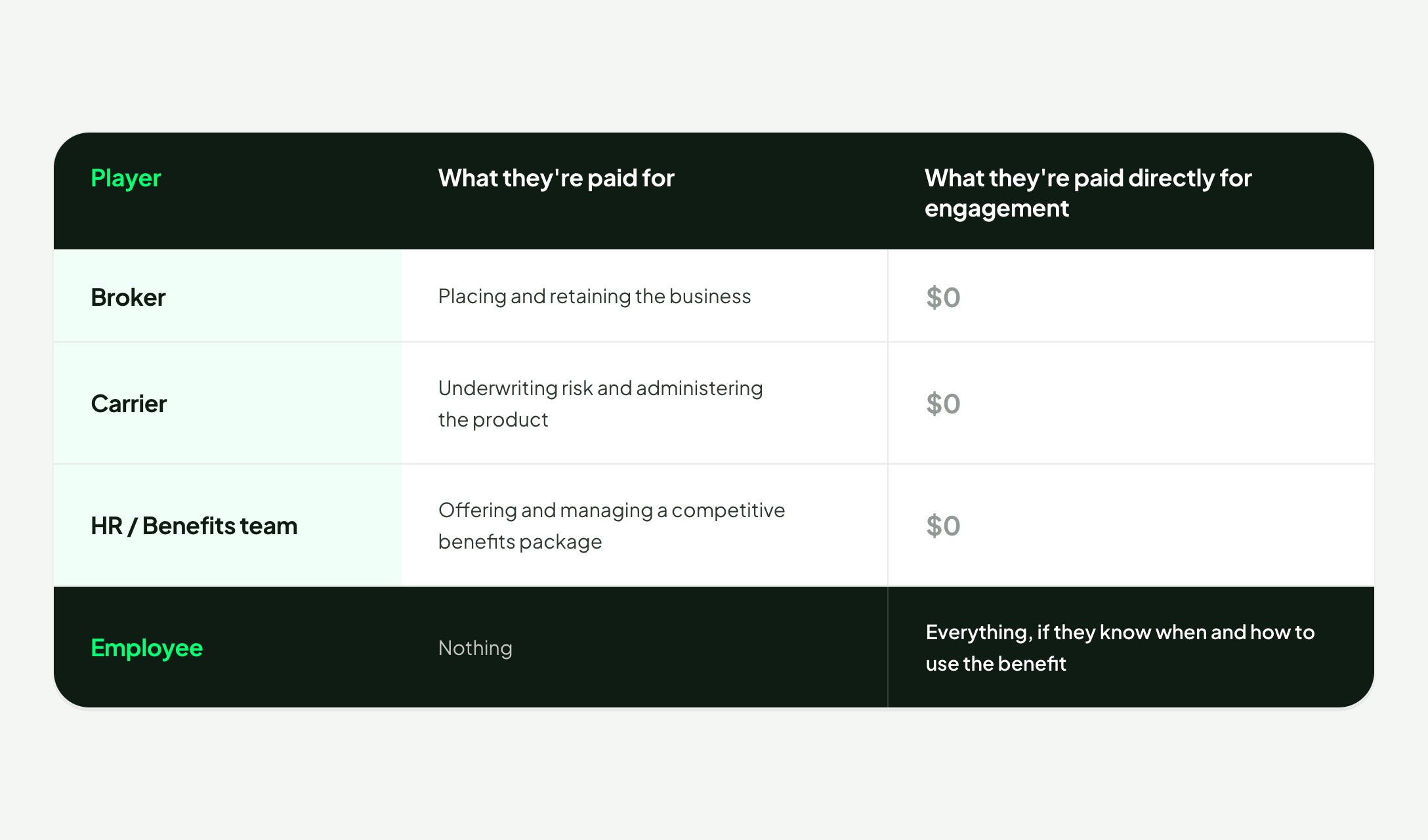
The $0 matters because engagement can absolutely create economic value for brokers, carriers and employers. It can support retention, persistency and a stronger employee benefits experience. The problem is that the market does not automatically assign one player to create that engagement between enrollment and renewal.
And that gap is where voluntary benefits tend to go quiet.
According to SHRM's 2025 reporting on year-round benefits engagement, employers still tend to concentrate benefits communication around open enrollment even though employees need repeated, relevant communication throughout the year to understand and use what they have.
Enrollment gets the attention. The months after enrollment often do not.
What changes when a broker owns engagement, not just placement?
Once a broker moves from just selling a policy to making sure it actually gets used, the role changes. That's the difference between a transactional middleman and a strategic advisor a client trusts.
According to LIMRA's 2025 research, 79% of employers turn to brokers or benefits advisors to help identify and evaluate benefit options. LIMRA also found that brokers are increasingly expected to help employers manage benefit costs, navigate regulation and identify the digital capabilities that fit their workforce.
That is a much broader job than getting employees through enrollment.
The upside is concrete:
- Client retention. A client has more reason to keep a benefit when there is evidence that employees understand it, interact with it and see value in it. LIMRA 2025, found that more than 60% of workers say their benefits package makes them at least somewhat more likely to stay with their employer, which shows how much employee perception of benefits can matter beyond the enrollment transaction.
- Protected renewal economics. Brokers may not receive a separate engagement check, but engagement can matter to the persistency of the business they placed. LIMRA's 2025 Workforce Benefits Study found that employer focus on economic value is changing what clients expect from their brokers, based on research with 800 U.S. employers, approximately 2,000 workers and leaders from 12 large brokerage houses and general agencies.
- Competitive differentiation. When multiple brokers can quote similar products, the broker who can explain what happened after enrollment has a different story to tell. The conversation moves from “here's what we placed” to “here's what employees actually did with it.”
Imagine two brokers walking into the same renewal meeting, one brings enrollment numbers and the other brings enrollment numbers plus a year of participation: where employees engaged, which experiences brought them back, where utilization fell and what can be changed before the next enrollment.
Same client but very different renewal conversation.
That is the difference between treating voluntary benefits as a transaction and treating them as an ongoing client strategy.
How can brokers keep engagement alive between enrollment and renewal?
Keeping engagement alive takes rewriting the rules the product runs on, not just better reminders. This is where Betterfly changes the model, tying health, wellness, and financial protection into one experience employees can interact with throughout the year.
That distinction matters because communication alone is still a problem. In 2025, SHRM reported that employers often concentrate benefits communication around open enrollment, even though employees need repeated and relevant touchpoints throughout the year to understand, value, and use what they have.
Betterfly changes what happens during those months between enrollment and renewal:
- Daily prevention, not just protection. Betterfly gives employees reasons to interact with their benefits before something goes wrong. Daily missions, health challenges, preventive health insights, and mental wellbeing services bring health into the experience throughout the year. Across more than 2,000 enterprise clients in Latin America and Europe, 1 in 2 employees take action to improve their health within the app, and 44% turn that activity into a consistent monthly habit.
- The engagement loop. Healthy actions such as walking, training, and participating in challenges can earn Betterflies. Those Betterflies connect participation to tangible value including discounts, gift cards, donations, and other benefits within the Betterfly experience. Members can also connect activity from 100+ apps and wearables, giving everyday health actions a visible place inside the experience.Betterfly U.S., 2026 The point is the loop: action → progress → value → another reason to come back.
- Visibility for HR and brokers. Engagement also creates something the renewal conversation usually lacks: evidence. Betterfly gives HR and brokers visibility into adoption, utilization, participation, enrollment, and engagement metrics. The U.S. broker experience is designed around real-time enrollment visibility plus data brokers can bring into renewals and client check-ins.
That last piece matters because the problem is bigger than getting employees to open an email.
Betterfly's U.S. model works as a flywheel: employee engagement produces richer behavioral and preventive information, that information supports more relevant interventions, and those interventions give employees another reason to participate. Betterfly, How Betterfly Works, 2026
That is a better way to benefit. Employees experience value between enrollment and renewal, while brokers and HR have something more useful than an enrollment total to bring into the next voluntary benefits renewal season.
Why engagement has to be built into the product
A benefit that only proves its value after something goes wrong will always look underused. A benefit that proves its value every week doesn't need anyone to manufacture engagement. The product does that on its own. Brokers who bring that structure to their clients walk into voluntary benefits renewal season with a real story, not another excuse for a quiet report.
See what real engagement looks like before your next renewal conversation. Learn more about Betterfly.
Sources:
MetLife — Employees Report (https://www.metlife.com/about-us/newsroom/2025/september/new-metlife-data-finds-half-of-employees-report-feeling-disconnected-undervalued-at-work/)
SHRM — Strategies to Sustain Employee Benefits Engagement Year-Round (https://www.shrm.org/topics-tools/news/benefits-compensation/8-ways-to-sustain-employee-benefits-engagement-year-round)
LIMRA — Changing Role of Workplace Benefits Brokers (https://www.limra.com/en/newsroom/industry-trends/2025/limra-research-the-role-of-workplace-benefits-brokers-is-changing/)
LIMRA — Trends and Growth Opportunities in Workforce Benefits (https://www.limra.com/en/research/research-abstracts-public/2025/harnessing-growth-in-workforce-benefits-the-next-horizon--2025-workforce-benefits-study/)